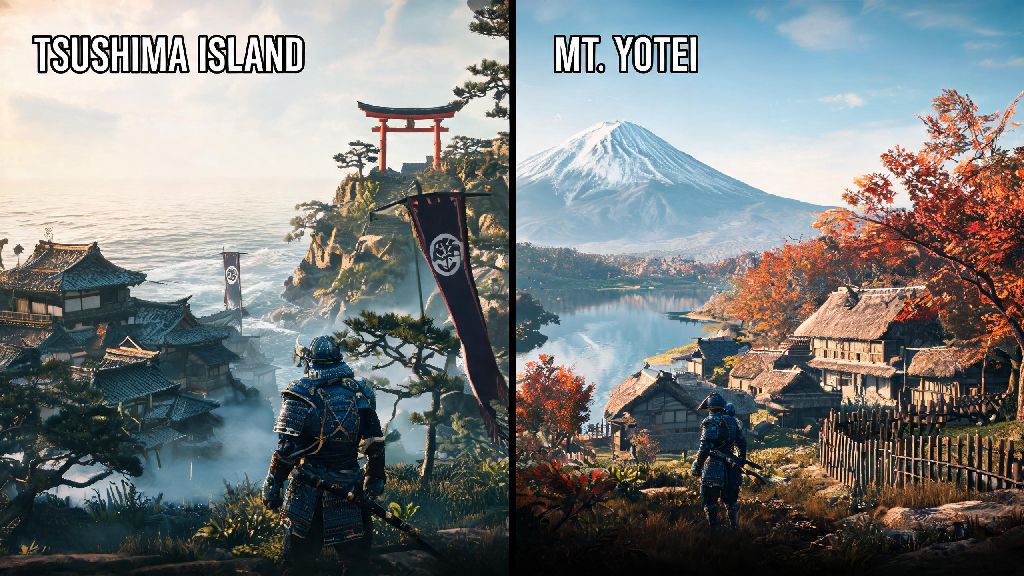
If you’ve spent any time scrolling samurai game forums or waiting for updates from Sucker Punch Productions, you’ve almost certainly seen debates around ghost of yotei vs tsushima pop up every few weeks. Both games are set in feudal Japan, follow rogue warrior protagonists, and lean into that signature blend of open-world exploration and tight, satisfying combat the studio is known for. But they’re far from the same experience, and picking which one to dive into first (or replay for the tenth time) depends a lot on what you value most in a game. I’ve put 120+ hours into Tsushima across its base game and Iki Island expansion, and spent the last few months picking apart every leaked detail and official reveal for Yotei, so I can break down exactly how they stack up side by side.
Core Lore and Setting: Ghost of Yotei vs Tsushima
Tsushima’s story is rooted in real historical events, set during the 1274 Mongol invasion of the real Tsushima Island. You play as Jin Sakai, the last surviving samurai of his clan, who is forced to abandon strict samurai traditions to save his home and people from being wiped out by invading forces. The story leans heavily on themes of honor, sacrifice, and loyalty to your community, with very few creative liberties taken from the actual historical record of the invasion.
Yotei, by contrast, is set in 1603 at the very start of the Edo period, a time of massive political upheaval as Japan shifted from centuries of civil war to a period of unified shogunate rule. The game takes place in the northern island of Hokkaido, centered around the iconic snow-capped Mount Yotei, and follows a fugitive female samurai running from her past in the mainland. Tsushima’s lore is rooted entirely in defense of home, while Yotei’s story focuses on identity, belonging, and surviving in a harsh, untamed frontier. Sucker Punch has also confirmed they’re working closely with Ainu cultural consultants to portray Hokkaido’s indigenous communities accurately, a layer of representation completely absent from Tsushima’s more homogeneous island setting.
Gameplay Mechanics and Open-World Design
Tsushima’s open world was widely praised for its stunning art direction and immersive atmosphere, but many long-time players noted it felt relatively empty once you cleared all Mongol camps and completed the main story. Most side content boiled down to simple fetch quests or collectible hunts, with very few dynamic events to keep you engaged during casual exploration. Yotei looks like it’s addressing that gap directly, with a more living, reactive world that changes based on your choices and actions.
We’ve seen a handful of confirmed gameplay changes that set Yotei apart from its predecessor, including:
Traversal is also getting a massive overhaul, with more fleshed-out climbing mechanics that let you scale almost every surface of the 30% larger map, including the steep slopes of Mount Yotei itself. Yotei’s open world is roughly 30% larger than Tsushima’s base map, and every region has its own unique ecosystem and branching side quest lines that don’t feel like generic filler content, based on early playtest leaks.
Combat System Differences and Playstyle Options
Tsushima’s combat system is still widely considered one of the best in any modern action game, with four distinct stances tailored to different enemy types, tight parry and dodge windows, and a suite of ghost weapons like smoke bombs and kunai for stealth players. But even on the hardest difficulty, many veteran players found it too easy once they mastered the stance system, with very little room for creative combo building or experimental playstyles.
Yotei keeps the core of that satisfying combat loop but adds a long list of quality of life changes and new mechanics to keep things fresh. Stance switching mid-combo is now fully supported, so you can chain a heavy stone stance attack to break an enemy’s shield into a quick wind stance flurry without pausing, opening up hundreds of new combo options for players who want to master the system. There are also new environment-specific combat mechanics, like kicking enemies into frozen lakes to take them out instantly, or throwing snow in their face to stun them if you run out of smoke bombs.
The new protagonist’s fugitive status also opens up more stealth and non-lethal play options that were almost impossible in Tsushima. You can hide in deep snow drifts to avoid detection, and take down enemies without killing them if you want to avoid drawing attention from local authorities. Non-lethal playthroughs are fully supported in Yotei, with separate story endings and unique side quest rewards for players who choose not to kill their enemies, a feature that was heavily requested by Tsushima fans for years.
Which Game Should You Play First?
The answer to that question depends entirely on what you’re looking for in a game. If you want a polished, complete experience with a tight, emotional story that’s already been out long enough to have all DLC and bug fixes available, Tsushima is the obvious pick right now. It’s accessible for new players, has a very gentle learning curve, and you can often find it on sale for less than $30 at most major game retailers.
If you prefer games with more experimental mechanics, survival elements, and a story that focuses on personal identity instead of war and sacrifice, you can either wait for Yotei’s launch, or play Tsushima first to get a feel for Sucker Punch’s core design style. You don’t need to play Tsushima to enjoy Yotei, since the two stories are set hundreds of years apart and have completely separate casts of characters, but there are small Easter eggs and lore callbacks for players who have finished the older game that make the experience feel more connected. If you care about getting the most out of every small lore detail, playing Tsushima first is worth the time investment.
At the end of the day, ghost of yotei vs tsushima debates don’t have a clear “winner” because both games cater to slightly different player preferences. Tsushima is a timeless classic that set the bar for samurai open-world games, and it’s still just as fun to play today as it was when it first launched. Yotei looks like it’s building on that solid foundation to create a more dynamic, flexible experience that rewards creativity and roleplay more than its predecessor. No matter which one you pick first, you’re in for a gorgeous, action-packed journey through feudal Japan that’s worth every hour you put into it.